
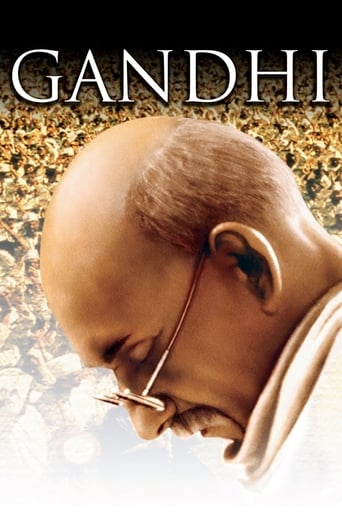


Gandhi (1983)
In the early years of the 20th century, Mohandas K. Gandhi, a British-trained lawyer, forsakes all worldly possessions to take up the cause of Indian independence. Faced with armed resistance from the British government, Gandhi adopts a policy of 'passive resistance', endeavouring to win freedom for his people without resorting to bloodshed.
Watch Trailer

Cast


Similar titles





Reviews
One of my all time favorites.
A film of deceptively outspoken contemporary relevance, this is cinema at its most alert, alarming and alive.
One of the film's great tricks is that, for a time, you think it will go down a rabbit hole of unrealistic glorification.
The movie really just wants to entertain people.
Gandhi is a person who has won the hearts of people with his life vision and philosophy. There's so much to say about her. I think it's a great pioneering biography. The film has the most crowded scene of cinema history. I want to congratulate the movie actors and especially Ben Kingsley. He gave more than the role he played. I want to finish with Gandhi's terrific promise. "Yes I am, I am also a Muslim, a Christian, a Buddhist, and a Jew."
The biographical drama "Gandhi" was written by John Briley and directed by Richard Attenborough. It was released in 1982 and received 8 Academy Awards and Golden Globes for Best Director and Best Foreign Film in the following year. Richard Attenborough had attempted to get the project made for 18 years which demonstrates how much determination and passion were spent during the making of the film. Ben Kingsley, a British actor who, portrays Mohandas Gandhi in the film also received an Academy Award for Best Actor. The 74 year old is also well known for his performances in the films Schindler's List (1993), Shutter Island (2010), Iron Man 3 (2013) and many more. The film is about Mohandas Karamchad Gandhi's life as the leader of the Indian non-violent independence movement against the British rule in the 20th century. It begins with Gandhi's assassination on 30th January 1948, when he was shot three times by a Hindu fanatic named Nathuram Godse (Harsh Nayyar). The film goes on with a defining moment in Gandhi's life, when he is thrown off a train to Pretoria, South Africa in 1893 because of racial injustice. This particular moment convinces Gandhi to fight for equal rights for Indians first in South Africa, later in India.The film also shows Gandhi's salt march and other projects. The actors in the film were appropriately cast, because the film's production was a British-Indian cooperation and there are British and Indian actors. Ben Kingsley was a good choice as the protagonist because of his Indian heritage and great acting skills. Most of the acting is well done, especially Ben Kingsley let everyone truly imagine what the real Mohandas Gandhi was like. The viewer can see what life was like in India in the 20th century and what Gandhi, his family and his huge community was like. Ben Kingsley plays Gandhi very convincingly throughout the whole movie. The use of camera is very good because it was filmed from different angles. These angles are switching a lot to illustrate the different point of views, for example almost at the end of the movie, when Gandhi is really weak from his fast and everyone is standing around his bed, we can see all the visitors from Gandhi's perspective. This technical element creates a very diversified perspective which in my opinion is well done. The lighting contributes, like the sound to the setting and atmosphere of the film and increases the intended effect of the film. This can be seen during the different phases of Gandhi's life. At the beginning of the film, when there are only a few followers of his independence movement, these followers shout approvingly but hesitantly at him during his speeches. Later, the crowds get bigger and bigger and the people begin to shout "Long life Gandhi-j!". In contrast to these scenes, Gandhi's growing unpopularity can be seen rather at the end of the film when the crowd screams "Death to Gandhi!". I think this use of sound and also of special effects is rather interesting because it demonstrates how the masses saw Gandhi throughout his life. At the end of the film, which shows Gandhi's death from a different perspective, it can be seen how Hindu fanatics are willing to kill Gandhi because they think he is too friendly with Muslims and Christians. All in all, I think "Gandhi" is a good film because it lets the viewer get a look inside Gandhi's life and it shows his whole personality including his fears and dreams for himself, but more importantly for India. In my opinion, his family especially his children could have appeared more frequently because they are a part of his life, even though they don't seem to play a big role. Their relationship could have been touched a bit more, since it would have been interesting to see him as a father. Of course, he is or appears to be the father of India and especially India's independence but in this film it seems like he is almost a stranger to his own children. Even if that is true, this relationship would have been a significant and very interesting addition to the film which I would have really liked to see. Despite these critical remarks, I consider the film a successful one and recommend watching the film because the viewer gets an idea of Gandhi's lifestyle and personality, including his fight for equality, his philosophy of non-violent protest and his wish to see the world at peace.
The 1982 film "Gandhi", written by John Briley and produced by Richard Attenborough, tells the story of Mahatma Gandhi's life.At the beginning of the film we witness Gandhi's assassination from the perspective of the assassinator. I really liked that scene because the viewers get to see the assassination through his eyes, including Gandhi being shot. However, the scene wasn't fully shot from the assassinator's perspective. The viewers also get to see his face in a close up and someone who appears to be his accomplice. To me this scene has some kind of deeper meaning, especially when taking into consideration how the movie ends but I will get to that later on. Another thing I like about this opening scene is that the assassinator and his accomplice appear a few times throughout the movie. I think that's a nice detail and to me it seems like a metaphor, showing both, Gandhi's followers and opponents in the same scene without them actively having a conflict.The movie then goes back to 1839 when Gandhi, being a middle aged father and lawyer, gets confronted with the unfairness of society in South Africa. He is thrown off of a train because he sits in a train compartment which he isn't allowed to sit in. I liked that scene because it gives the viewers a first impression on Gandhi's personality in comparison to the construct of society at that time.After that the movie is filled with many powerful scenes showing the peaceful protest against the violence of the British police, as well as the violent conflicts between Hindus and Muslims. Another thing that I liked about the movie is the development of Gandhi and his growing audience. While at the beginning of the film we see Gandhi in a suit talking to a handful of people, at the end we see him in his simple white clothes followed by an uncountable amount of people. In addition to that, I think the scenes of his fasts and his time in prison are really impressive, not only because of the way Gandhi handled the situation but also the people around were really emotional. There's one part of the movie which I think is really precious and adds some nice details to it. By that I mean Gandhi's relationship to his wife. I absolutely adore the way the movie shows that Gandhi is still just human like everybody else, even though he did such impressive things. It is shown that he cares for his wife and stays by her side all the time, though he had some inner conflicts about that at the beginning of the movie. Their love seems so pure and honest which to me is a balance to the way Gandhi is presented throughout the rest of the film. Especially when she dies the movie seems to only focus on that for a few minutes. This is also the only scene when Gandhi cries. He smiles a lot throughout the movie even in the most difficult situations but in that scene he is shown as a man losing his wife and nothing more than just that. This is why this is one of my favourite scenes in the film. However, there are some scenes in the movie that bother me. One thing I didn't like about the movie is that there are some scenes where the characters would just a have talk for a while which made me lose interest in the movie a few times because the characters seemed to repeat themselves a lot instead of having short, impressive scenes which the viewers actually keep in mind. Another thing I don't particularly like is that sometimes the movie seems to show Gandhi as some kind of god. It is in fact true that many people saw him as a hero but sometimes it was simply too much of praise because it wasn't necessary for the viewers to see that over and over again.At the end of the movie we get to see the assassination scene again but this time from the perspective of Gandhi. Like I said before I think that scene is really impressive especially when comparing the beginning and the ending of the film. It is basically the same scene but we get to look through Gandhi's eyes. It is slightly different to the first scene because we get so see the last steps Gandhi takes as well as the last thing he sees and his last words, when at the beginning of the movie we see the way the assassinator takes and his perspective on it which is why at the end, instead of showing Gandhi's death again, the screen turns black and we hear his last words. I really like how the movie presents those two perspectives because it shows both, the part that loved Gandhi and the part that wanted to see him dead. All in all, I can say that I enjoyed the movie not just because of the story showing Gandhi's life but especially because of the little details which really turned the movie into this impressive piece of art. I would absolutely recommend that movie to anybody who wants to see the historical facts about Gandhi within a biographical drama movie.
A movie about a thin man wrapped in a white sheet and therefore dressed like one of the poor in India. Who would be interested in that? But with eleven nominations and eight Academy awards it is clear that the biography of this man is not that uninteresting. Actually, it is the story of the most important man in the history of not only India and its fight for independence but also for the whole world. Richard Attenborough's Gandhi, starring Ben Kingsley, was published in 1982, 34 years after the actual assassination of Mahatma Gandhi. This is also the opening scene of the movie, followed by the statement that he was even more powerful than empires. Right from the beginning it is clear which effects Gandhi had on his environment. It goes on with the young Gandhi, who is a lawyer being discriminated in South Africa, causing him to protest against the injustices that are caused by the British and after that him being imprisoned. The first of several more times. Again free and back in India, he begins to travel the country together with his wife to "see what needs to be told". He also begins to dress like the poor and, after seeing the bad circumstances in his country caused by the British Raj, he starts to bring people to question things and starts to fight for India's independence. He calls up for a peaceful non-violent noncooperation but the riots get out of control. Gandhi begins a hunger strike to stop them, which actually works out, but still, he gets arrested again, this time for six years. India's independence has nearly arrived as he is allowed to leave. As a last peaceful protest he organizes the Salt March against British salt taxes. He is still underestimated by the British Raj, but as thousands follow his example, it comes to mass arrests. Then, throughout the Second World War, the British are wounded and can no longer hold onto the government of India. Gandhi uses this weakness to request the release of all his imprisoned followers and India's independence. The conclusion of that is on the one hand the independence of India but on the other hand the partition of India into a Hindu India and a Muslim Pakistan (even though he is strictly against this), which causes a brutal civil war. Again, Gandhi starts a hunger strike so that the fighting stops and both sides promise to "die when they lay their hands on each other". Gandhi then plans to go to Pakistan but even after everything he did, there is still a sadness about him that he thinks of having failed. He then makes his way up to a prayer, followed by crowds of people, where the movie ends where it has begun: his assassination. All in all, the biography is really impressive. It does not only show his life and the very key moments of it, but also gives a view into his way of thinking. Throughout the whole movie it gets clear how important nonviolence is to him and how he achieves enormous things by this different, peaceful and unique kind of protest. It also shows how critical he was with himself and how he wanted his environment and the people from all over the world to accept and love each other. The actors are also well chosen so that Gandhi could be shown in a timespan of 50 years of his life and how he grew with his actions and words. The only critic is that 188 minutes is a really long time for a movie, but otherwise there is so much to tell about this thin man wrapped in a white sheet and his life story, that probably another three hours could be easily added.