
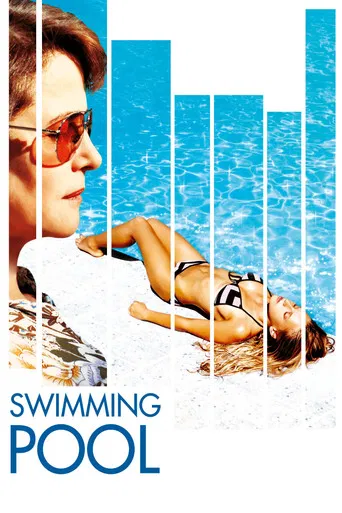

Swimming Pool (2003)
A British crime novelist travels to her publisher's upmarket summer house in Southern France to seek solitude in order to work on her next book. However, the unexpected arrival of the publisher's daughter induces complications and a subsequent crime.
Watch Trailer

Cast





Similar titles






Reviews
one of my absolute favorites!
It’s not bad or unwatchable but despite the amplitude of the spectacle, the end result is underwhelming.
Amazing worth wacthing. So good. Biased but well made with many good points.
The story-telling is good with flashbacks.The film is both funny and heartbreaking. You smile in a scene and get a soulcrushing revelation in the next.
Sarah Morton, a middle-aged English writer specialising in detective novels, goes to stay in a country villa in France owned by John Bosload, her publisher, in order to work on her new book. One day Sarah is surprised to find a young woman in the property and, assuming that she is a trespasser, asks her indignantly what she is doing in the house. The girl, Julie, explains that she is John's daughter, and that her father has given her permission to use the house. Sarah and Julie begin to live together in the house, but theirs turns out to be an uneasy relationship because of their very different lifestyles. Sarah is looking for peace and solitude to concentrate on her writing, but her life is constantly disrupted by the brash, noisy Julie who brings a succession of lovers back to the house.At first the film seems to be developing into a comedy of manners (or perhaps a comedy of bad manners) based around the contrast between a stereotypically sexually and emotionally repressed English spinster and a stereotypically sexually uninhibited French girl. (Julie is half-English but has a French mother, one of John's former mistresses, and has lived all her life in France; she speaks English with a heavy accent). Sarah is disgusted and, at the same time, secretly fascinated by Julie's irregular sex-life. There is even a hint of a lesbian attraction towards the younger woman; it is notable that whenever Sarah is looking at Julie the camera seems to zoom in lovingly on Ludivine Sagnier's generally scantily-clad body.And then, suddenly, the film takes a sinister turn and becomes not a comedy but a sort of mystery thriller. Franck, a waiter in a local café and one of Julie's many boyfriends, disappears, and Sarah suspects not only that he may have been killed but also that Julie may be responsible.In his review of the film Roger Ebert stated that "François Ozon (the director and co-writer) understands as Hitchcock did the small steps by which a wrong decision grows in its wrongness into a terrifying paranoid nightmare". He was not the only critic to draw a comparison with Hitchcock, but I wonder if such critics actually saw the same film as I did. To begin with, it is normally random chance which plunges Hitchcock's heroes and heroines into a terrifying nightmare, without the need for any wrong decision on their part. (Think of Roger Thornhill in "North by North-West" or the married couples in the two versions of "The Man who Knew Too Much"). Ebert may have been thinking of Marion Crane in "Psycho", who does indeed find herself in a nightmare as a direct result of stealing from her employer, but she is not really typical of Hitchcock's characters. Secondly, in "Swimming Pool" the "nightmare" arrives suddenly out of the blue rather than by small steps. In a matter of minutes Julie goes straight from performing a sex act on Franck to battering him to death with a rock, without any motive ever being given. The only possible explanation is that Julie is mentally deranged, but even if one accepts this explanation one still has to explain why Sarah should help an insane murderer to dispose of the body and to cover up her crime.The ending of the film has been described as "ambiguous". It has been suggested that Sarah has been alone at the villa all the time and that Julie, Franck and some of the other characters only exist in her imagination as characters in the novel she is working on. Now I am well aware that the idea of a work of fiction supposedly created by an author who is himself or herself a character in a larger work of fiction is a variety of what has become known as "metafiction" and is one of the games which authors sometimes play with their readers. This game, moreover, can be a very effective literary advice; something similar occurs in Ian McEwan's novel "Atonement", and I have great admiration both for that novel and for the film which Joe Wright made of it. The concept of "metafiction", however, does not serve to turn a bad plot into a good one, and the plot of "Swimming Pool", whether one regards it as having been created by the real Francois Ozon or the fictional Sarah Mason, is a pretty poor one with more holes than a colander. Moreover, when I was watching the film myself it never occurred to me that Ozon might be playing metafictional games; I assumed that we were supposed to take everything that happened at the villa at face value.The titular swimming pool, which plays a part in the story, and the theme of two women trying to dispose of the body of one man, may have been intended by Ozon as a reference to Clouzot's "Les Diaboliques", but his film cannot bear comparison with that masterpiece of the French cinema. Nor, pace Mr Ebert, can it bear comparison with "Psycho" or Hitchcock's other classics. Even the Master's weaker movies ("Stage Fright", "Torn Curtain", etc.) were normally more coherent than this. In terms of quality about the only Hitchcock film I would compare it to would be something like "Jamaica Inn", but then I have always considered that to be Hitch's worst film. It would have got a lower mark but for a decent acting contribution from Charlotte Rampling. 4/10
Essentially this is a French film: it was written and directed by a Frenchman François Ozon and it was shot by a French crew almost entirely on location in the south of France. But the lead actress is British and half of the dialogue is in English. Charlotte Rampling plays Sarah Morton (actually the name of Rampling's sister who killed herself at the age of 23), an English crime novelist who wants to craft something different. She is offered the use of her publisher's home in rural France where unexpectedly she comes across his daughter Julie played by Ludivine Sagnier. The two women are utterly different and the film - a slow-burning thriller - explores the developing relationship between them and its mysterious consequences with an ending that is highly ambiguous. We think of French films as often involving nudity and there is plenty on show here. Both actresses are beautiful and sexy although, at the time the film was made (2003), Rampling was in her late 50s and Sagnier in her early 20s.
Swimming Pool (2003): Dir: Francois Ozon / Cast: Charlotte Rampling, Ludivine Sagnier, Charles Dance, Jean-Marie Lamour, Marc Fayolle: Spellbinding erotic mystery about beauty, lust, age, dysfunction, and what emerges from the pool whether it be fall leaves or the captivating image of young skin. It stars Charlotte Rampling as a successful mystery writer who is sent to her publisher's holiday home to rest and regain her composure for writing. Peace and quiet are interrupted by the arrival of her publisher's French daughter played by Ludivine Sagnier who is loud, obnoxious and brings home an array of males for a night of sinful passion. What is most fascinating is its reality and fantasy base that is never clear but then again, that is the point. Was a murder committed or is it just the prize of a latest bestseller? Director Francois Ozon brings viewers deep into the mind and reality and is backed by tremendous performances by Rampling and Sagnier with an underwritten role by Charles Dance as the publisher who is only present when convenient for the plot. Jean-Marie Lamour appears as a male caught within Sagnier's web of passion and regrets it severely. Marc Fayolle also makes an appearance as a character named Marcel. While some elements aren't exactly clear, it does play like a mystery novel within slick compelling filmmaking and peep show. Score: 7 ½ / 10
SWIMMING POOL is a laid-back, sensual thriller with top-notch performances by Charlotte Rampling and Ludivine Sagnier. The story is about a British crime novelist, Sarah Morton (Rampling) who, lacking in inspiration, is allowed by her publisher to vacation at his French home to begin work on a new novel. Trouble starts when his daughter shows up unexpectedly and begins to turn things upside down for the uptight novelist. Gradually, Sarah starts to come out of her shell and then things take a turn I didn't expect (which I'll leave unsaid). The best thing about this incredible film are the great performances given by Charlotte Rampling and Ludivine Sagnier (as Sarah's publisher's daughter). They bring so much depth to their characters and every scene they share is a treat to watch. Also of note is the eerie, mysterious score which does an excellent job at setting the tone of the film. The film is also shot very well, with lots of beautiful location shooting on the French countryside. The only negative I could find was a scene about two thirds of the way through when Julie (Sagnier) brings home a waiter who Sarah happens to know, and they have a little dance party. It was more the choice of song than anything, although the scene was rather awkward in and of itself. Still, this only reminds me why I love French films, especially thrillers like this one. Highly recommended.