


The Wanderers (1979)
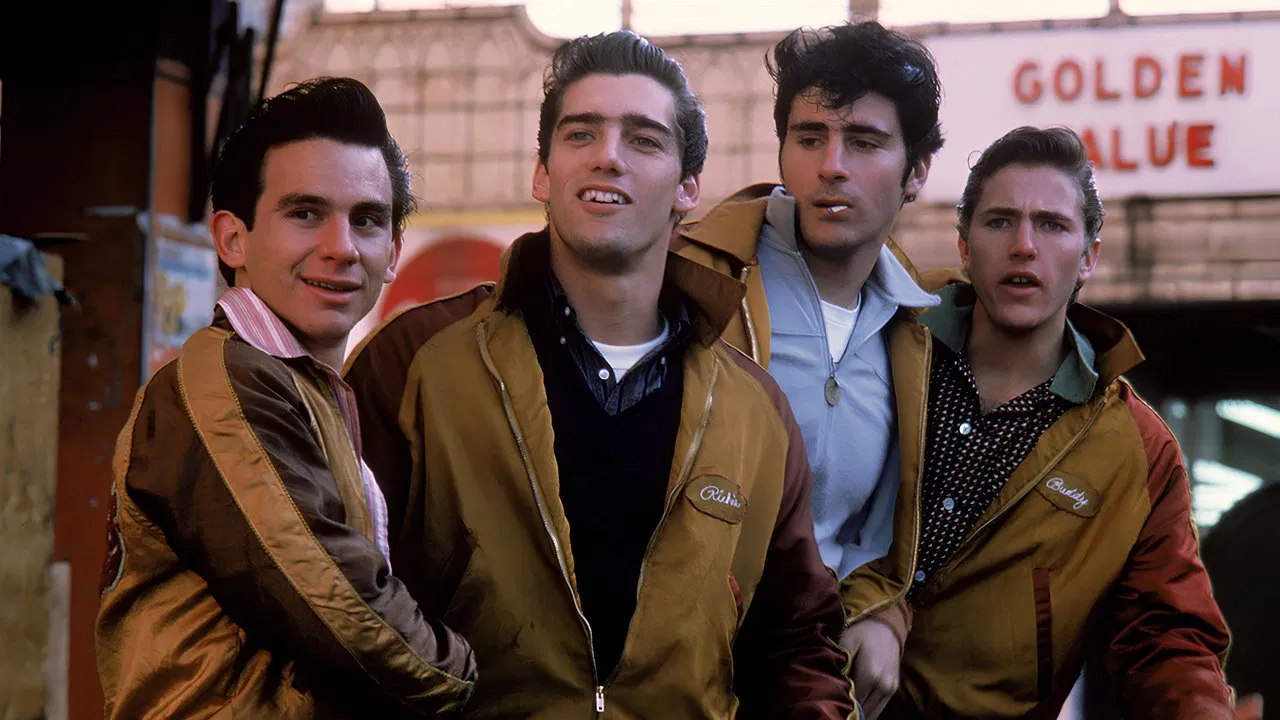
The streets of the Bronx are owned by '60s youth gangs where the joy and pain of adolescence is lived. Philip Kaufman tells his take on the novel by Richard Price about the history of the Italian-American gang ‘The Wanderers.’
Watch Trailer

Cast


Similar titles





Reviews
Brilliant and touching
The film makes a home in your brain and the only cure is to see it again.
The film's masterful storytelling did its job. The message was clear. No need to overdo.
.Like the great film, it's made with a great deal of visible affection both in front of and behind the camera.
This was a good movie about growing up in The Bronx in 1963, where the country was going thru unfortunate events of 1963. The actor who did "Terror" was great & played an inmate in "Stir Crazy" and used his aide to let the inmates escape. The Ducky Boys were great and I wonder what they did when President Kennedy got shot? The Ducky Boys are a classic gang that I would keep a long distance from. I wonder if they respect strange black girls in vintage funeral cars, 1951-54 Packard Funeral Cars? I did like the Marine Recruiter because he reminds the spirit of B.B. Daniel a man who's estate was also on a corner & when his area becomes a building center. The Marine guys would say, "I got a way for all of you to stomp all the heads you want & make the world safe for democracy at the same time." And despite Turkey is in the group, they leave him behind & screaming for his departed buddies and crying out the name of "Terror" like he was some god-like being. It looked like no one saved Turkey from The Ducky Boys. In the book when they called in confession they would get 10 lashes with a car antenna & both the priest and the receiver bow to each and shakes hands because being part of The Ducky Boys, you take punishment as you dish it out. Poor Turkey and proved he made a bad choice in his life. Terror & Pee Wee reminds me of my grandfather & his second wife if they were their ages. Erland was a great, Terror. As for Alan Rosenberg he should got supporting Oscar as Turkey & yelling, "TERROR, BALDIES, WHERE ARE YOU? SAVE ME TERROR! I'M GOING TO BE KILLED BY THE DUCKY BOYS!" Alan showed us he's a good actor. Marcus Brainard
I saw this flick when it first came out. I loved it then and love it now. There was a whole bunch of these kinds of 50's – 60's nostalgic movies that were pumped out during the 70's. Some were almost depressing (like, 'The Lords of Flatbush') and others were too over-the-top (like, 'The Warriors,)- but the most fun, had to be this flick. What can I say? Take a spot of 'Grease'; add a splash of 'Wise Guys'; a sprinkle of 'Good Fellas'; and mix it all together with 'Friday Night Lights' and maybe flavor it with a little bit of 'Dazed and Confused'– and there you have it – 'The Wanderers'. I would highly recommend this movie for people who want to kick back, relax and just enjoy a movie about, 'The Times - Yes they are-a-Changing.' This movie's sudden era shift covers a painful transition for some and transcendence of enlightenment for others. The 50's 'greasers' to the 60's hippies transition is a sad reminder that we can never re- live our past, no matter how much we want to. A tasty bit of cinematographic candy...enjoy it...but remember...you may devour it. Or not...
Philip Kaufman's "The Wanderers" opens with a couple kissing on a couch. He wants to have sex, but she doesn't. "You're a guy," she says, worried about getting pregnant. "Guy's don't have to worry about their reputations!"Kaufman undermines her proclamation by immediately cutting to a shot of skinhead gang members gathering on a street corner, "Walk Like A Man" playing on the soundtrack. As the film progresses, Kaufman will use this scene (a horde of gangsters standing outside a military recruiting station, trying to recruit new members of their own) as a jumping off point to delve into such issues as loyalty, sex, racial tension, adolescent swagger and the pros and cons of machismo. In other words, the film is about guy's worrying about their status and reputations within their own little communities.More importantly, though, Kaufman takes this theme (male identity under threat) and then builds a sequel to his earlier picture, "Invasion of The Body Snatchers", creating a film which is more about migration, movements and group formation.The film's two main protagonists are Richie, leader of a gang called the Wanderers, and Joey, a kid with artistic aspirations. As the film unfolds, we watch as the various boys and men of the picture form cliques, join gangs and jump from one group to the next, always seeking the solace and protection that these ready made support-groups offer. All these gangs assemble at the end of the film, where they face off on a giant football field. The blacks, the Italians, the Chinese, the mafia, the sons, the fathers, all gather on the field, all in their own little testosterone filled groups, waiting for any excuse to release their rage. When that violent moment comes, however, they target not one another, but a ghostly group of men called "The Duckies", a seemingly phantasmic gang which Kaufman bathes in smoke and treats as a kind of supernatural force; even oppositional groups join forces to curb anxieties.After this multi-gang orgy, in which every creed and race teams up to defeat the spectral "Duckies", Kaufman undercuts the testosterone and exposes the normalcy of gang life. Scoring sex leads to dull marriages, acting tough leads to dead end jobs in the military, violence and machismo masks weakness and anxieties, gang peer pressure leads to death etc etc. By the film's end, everyone – despite their macho rebellion - is trapped in a future that's a conformist, carbon copy of the past. All except Joey, the artist who – like the artist character at the end of George Lucas' similar film, "American Graffiti" – jumps in a car and skips town. Don Siegel's 1956 film, "The Invasion of The Body Snatchers", dealt with a hostile group of aliens who sought to take over a small Californian town. The film used a "cultural invasion" from outer space to symbolise the annihilation of free personality in contemporary society.Kaufman's 1978 remake, however, saw "cultural invasion" as a blend of what sociologist Robert Park calls "migrations" and "passive movements". Migration as a mass movement usually entails a certain amount of cultural conquest (economic or political) and assimilation, whereas passive movements represent a more individualised negotiation of cultural boundaries within a society (in Kaufman's invasion film, the humans have to act like aliens who are themselves acting like humans, in order to survive. IE, conformity is itself a kind of parody of a fake humanity). In Don Siegel's film, actor Kevin McCarthy stumbles out onto a rural street and yells "They're here!", warning townsfolk of the alien invasion. In Kauffman's remake, the same Kevin McCarthy finds himself bumbling down a busy urban street, again yelling "They're here!"The relocation of the alien invasion from rural town to urban mega-city marks an important shift. By placing the alien invasion within a metropolitan centre the sharp distinctions between ethnic groups (blacks, Irish, Italian, Japanese, American, Commie etc) are down played while the question of the individual as Other within the large, alienating convolutions of the modern landscape takes precedence. In the modern world, individuality as a means of defining oneself against any number of groups becomes lost within the ubiquitous streamlining of social, ethnic, and religious differences, everyone essentially becoming the same in their differences.In Kaufman's next film, "The Wanderers", he again has a character yelling "They're here!", this time when the virus-like "Duckies" appear. Set against the changing nature of ethnic communities within the Bronx, the racial tensions of the film are resolved not by all the different races battling against one another in order to survive, but in the races "coming together" against an external, seemingly ghostly contaminant. Here it is conformity – the very alien behaviour that the humans rallied against in "Body Snatchers" – that allows the various gangs to band together and fight off the foreign invaders.Kauffman stresses that it is the basic values that the different gangs share (codes, morals, symbols, colours, lack of weapons etc), that allow them to identify with one another and band against the invading "Duckies". The "Duckies" themselves are perhaps a stand in for America's Vietnamese or foreign enemies, which Kaufman sees as a ghostly sham, a boogie man used to whip up home-grown fear.Why are the gangs so easily whipped up into fear? Because they all agree on boundaries to define themselves in relationship to other ethnic/racial groups. "The Duckies", however, refuse to acknowledge these basic values. They, like the aliens from "Body Snatchers", are an external social force that does not distinguish between race, ethnicity and religion, and are therefore threatening to the supposedly "distinct" and "anti establishment" (ie hypocritical) gangs, solely because of their non conformity.8.5/10 – Kaufman's use of surfing music predates "Pulp Fiction". Worth two viewings.
I was born and raised in California. I love the Wanderers for the many characters. It was great to see a different take on life in the sixties from mine. I can't believe I didn't know about this movie before. I love American Graffiti too. Just two different life styles of movies. I think all the actors did a good job. You have to cut some of them some slack since they had never acted before. I certainly have seen worse. To say that the Wanderers was the real American Graffiti. I don't think is correct. Just a different way of growing up. I don't think any of the big cities in CA have the same vibe as the inter-city feel of either the Bronx or any of the other Burroughs. All of the cities here are spread out. You know huge land mass. We didn't have the separation of kids by ethnicity. We were all civil to each other. There were some cliques. The jocks, cheerleaders vs the geeks and regular people. No clubs or gangs in my school. Maybe the big cities had some. Since I have never been to NY, I have to assume Richard Prices memories are correct. Just as George Lucas is correct of his teen years. I lived it, the same time period just as he depicted in his movie. CA was and still is a car culture. You had status based on your car, whoever had the coolest one was top dog. Everyone had to have a car to drive, even if it was your parents. We were always on the move. We had the parties just as they did, and listened to the same music, did the same dances. We didn't dress up for parties like in the movie. We were more laid back. School dress wasn't all that different either. I still love the music from that time. A huge Dion fan, always was always will be. We are as much the same as we are different. To reflect back it does seem like it was the best of times. Sometimes wish I could go back, it was great!