
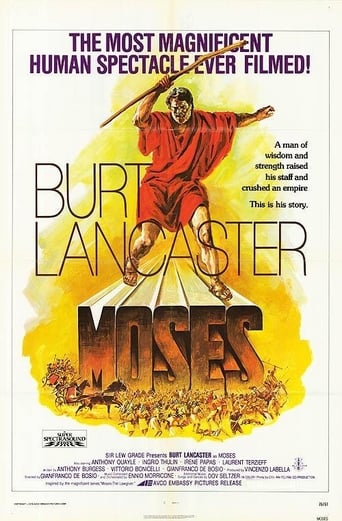
Moses the Lawgiver (1976)
The epic story of Moses, who led the Israelites out of slavery, parted the Red Sea and received the Ten Commandments on Mount Sinai. This is the edited-down version for theatrical release.
Watch Trailer

Cast



Similar titles


Reviews
Strong and Moving!
Slow pace in the most part of the movie.
In truth, there is barely enough story here to make a film.
I think this is a new genre that they're all sort of working their way through it and haven't got all the kinks worked out yet but it's a genre that works for me.
This was evidently made to go more into details about the Moses case than was possible in "The Ten Commandments" of 1956, which remains the best Moses film. For this version Anthony Burgess among other writers were consulted to make deeper research into the problems, which results in a much more interesting and controversial picture of Moses with his more debatable sides and complexities such as his cruelty and intolerance. We did not see much of Aaron in "The Ten Commandments" while he is here lifted forth to great advantage, convincingly played by Anthony Quayle, showing both his merits and weaknesses. After all, Burt Lancaster gives a sympathetic interpretation of Moses, which completes the efforts of Charlton Heston, who was only convincing and interesting as the prince and fugitive from Egypt. Best, however, is Laurent Terzieff as Pharaoh Mernephta, who is presented as a very conciliatory and human ruler placed in a very delicate and tough spot, - although he is historically entirely wrong. Mernephtah succeeded Ramses II at 66 years of age and did not rule very long, while he is here presented as a very delicate young man. It is more probable that Ramses was the pharaoh who had to deal with Moses, but that's the only flaw of the film, to which Ennio Morricone had great pains in making suitable music. The Red Sea sequence is as always the highlight of the drama, no film can fail in making that a great spectacle, and here is even included Miriam's celebrations afterward, which adds to the films many deserts.
not very large, not clear, almost a drawing. but impressive. I do not know if it is a great film. part of end of a period when Ben Hur spirit was master of Hollywood, it is difficult to define it more than part of a chain. but Burt Lancaster does an impeccable role. and for me, this film, like others, was a lesson of religion. under Communism regime, in Romania of 1984, when the churches are victims of strange architectural plans, when the faith was a form of resistance against the regime, Moses, this Moses, maybe fake, maybe theatrical, was a window. and , after years, not the film is important but crumbs of its memories. a great actor creates an unique character. and this character is perfect revolutionary. fragile, weak, strong, powerful, old and solitary. a master and a victim. the nuances of this base of the religions of Word are the gift of Lancaster. and his work is admirable.
I had high hopes when I bought this. Who knows, Burt Lancaster is not just any actor. But oh, was I wrong. Even though you have to consider the time (1974) when there were no blue screen and visual effects departments like in these days, the editor did a bad job. Beside that there more flaws. Simple things like 2 different baby's Moses... and the biggest question: where did the director get the story from? You don't have to believe in the Bible to watch this movie, but even then, the whole movie is based on things that are pure imagination of the director but have nothing to do with any of the biblical stories, or even Jewish tradition. It was a huge disappointment, and I advise everyone if they want to see a good movie, and closer to reality, to watch the movie classic the Ten Commandments.
This 2 hour version cuts out a lot of the interplay and character development of the mini-series that helps move the story along, and gives credence to the whole thing. If you can see the mini-series, do so.The best thing about both the short and mini-series versions is the score by Ennio Morricone. He has composed one cue that I, personally, believe is the finest single cue he has ever written, and that is saying a lot, what with OVER 400 scores to his name. And Morricone, himself, called this one of his most difficult works at the time, having to compose, thru modern means, a score that depicts an ancient time and place. The score is magnificent, heart-wrenching, and haunting.